If you are at all like me, you are probably trying to figure out how to form new habits. While there is plenty of advice for forming new habits on the internet, there is actually very little data about the topic. Even within the field of psychology, only two studies have examined habit formation with naturalistic longitudinal designs (Lally 2010 & Kaushal 2015). Since there is so little information on the topic, I dedicated my dissertation to solving a simple problem. I wanted to know what was more important for forming a new habit—is it the person, the habit, or the person-by-habit interaction?
To answer this question, I designed a study where undergraduate participants spent the semester forming two different habits. They spent half the semester (45 days) forming a habit of flossing before bed and the other half (45 days) forming a habit of drinking a glass of water upon waking up. They only developed one habit at a time. Participants also completed a brief five-question survey (the Habit Index-5; developed during my dissertation) that asks about how strong their new habits feel. I then aggregated these five items by day. So I have a self-report metric that reflects changes in habit strength at the daily level.
I had a few different theories for what the habit formation data may look like. After I finished the study, I cherry-picked a few participants who have data that illustrate my prior ideas.
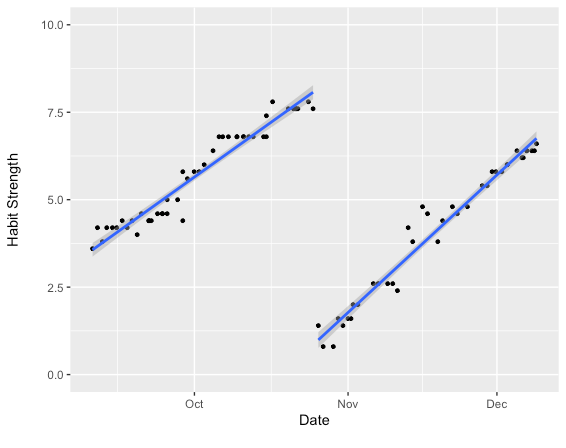
Theory 1: The person is more important than the habit
One possibility is that some people are just better at forming habits than others. So you might see one person fail to form both habits and another person do a good job at forming both habits.

Theory 2: The habit is more important than the person
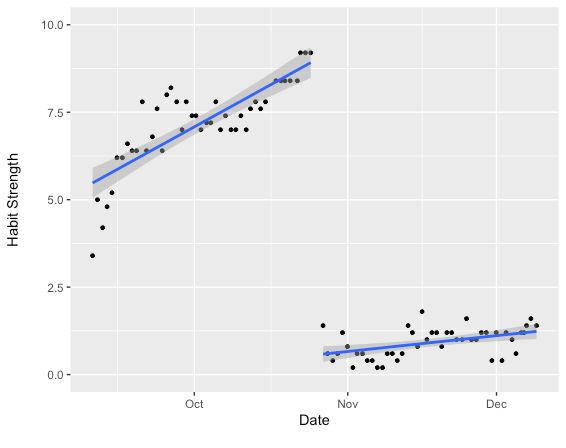
The idea behind theory 2 is that some habits are just going to be more difficult to form for everyone. So it might be that a habit of flossing is simply harder to form than a habit of drinking water first thing in the morning. Consider these two participants who did a good job at forming a habit of drinking water in the morning but struggled to floss before bed.
Theory 3: The person-by-habit interaction is actually the most important
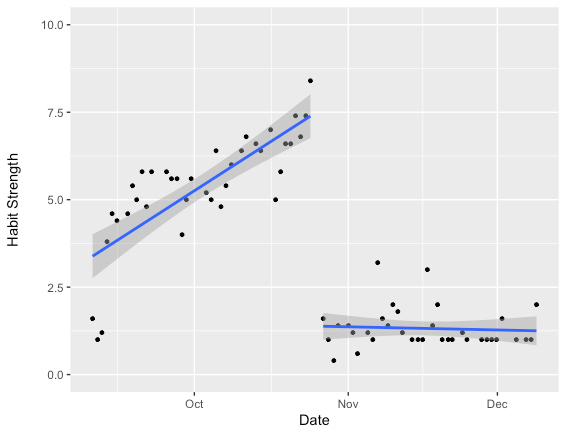
It might be that forming a habit actually depends upon the person-by-habit interaction. In other words, it’s all about finding a good fit between the person and habit choice. So maybe some participants were good at drinking water after waking up while others were good forming a habit of flossing before bed.

So what does the data actually say?
Theory 3 has the most support. I used generalizability theory (usually used in survey development) to determine the relative importance of the person, habit, and person-by-habit interaction. The person-by-habit interaction explained 41% of the variability in habit strength while the person explained 27% of the habit explained 4%. So the person-by-habit interaction is the most important facet and the person is a notable second.
What does this finding mean for you?
It means that you ought to pick habits that suit you if you want to be a successful habit former. One habit is not necessarily easier to form than another, it is going to depend upon you. But some people are also better at forming habits than others. So there might be a way to become better at forming habits in general. For example, some research shows that quitting bad habits (like smoking) leads to people adopting good habits (like exercise). So be picky about the habits that you try to form and work to make yourself a better habit former!
 Jake Quartuccio PhD